
Last Updated on 2026/07/11 by Tomylove
Quick Summary & Clinical Insight (TL;DR)
The Patient Health Questionnaire-9 (PHQ-9) is a premier, 9-question self-report screening tool used worldwide by clinicians to measure and monitor the severity of depression. Aligned with the DSM-5 diagnostic framework, this interactive online test evaluates key psychological and somatic symptoms over the past two weeks. By completing the diagnostic instrument below, you will receive an instantaneous screening score ranging from 0 to 27, paired with an evidence-based clinical classification matrix. Please note that this automated assessment is designed exclusively for educational and screening purposes and does not substitute for a professional medical diagnosis.

Recognizing the early signs of clinical depression is a crucial baseline step toward proactive mental wellness.
The Patient Health Questionnaire-9, commonly abbreviated as the PHQ-9, serves as the standard psychological instrument utilized by general practitioners, psychiatrists, and research professionals alike. Rather than executing a ambiguous qualitative quiz, the PHQ-9 adopts a rigorous, metrics-driven approach that quantifies individual depressive symptom criteria.
This mobile-friendly, instantaneous online utility allows you to evaluate your current psychological state in the privacy of your own digital space, delivering structured results immediately upon form completion.
Understanding the Science and Diagnostic Framework of the PHQ-9
The PHQ-9 is the dedicated depression module extracted from the full Patient Health Questionnaire, which was originally developed to streamline the identification of common mental disorders in primary care settings.
The instrument was meticulously designed by pioneering researchers Drs. Robert L. Spitzer, Janet B.W. Williams, Kurt Kroenke, and their academic colleagues.
Supported historically by an educational grant from Pfizer Inc., the tool was intentionally placed in the public domain to eliminate financial barriers to mental health screening worldwide.
Consequently, no formal copyright permission or licensing fee is required to distribute or utilize this test, making it an open-access gold standard for global healthcare systems.
What makes the PHQ-9 uniquely authoritative compared to casual internet quizzes is its direct correlation with the Diagnostic and Statistical Manual of Mental Disorders (DSM) criteria.
The nine specific prompts explicitly map onto the primary diagnostic criteria for Major Depressive Disorder (MDD).
These criteria encompass both emotional states, such as persistent dysphoria and anhedonia, and critical neurovegetative signs, including profound fatigue, cognitive concentration deficits, psychomotor agitation or retardation, and severe sleep cycle disruptions.

Interactive Assessment: The PHQ-9 Screener
To achieve an accurate screening metric, please evaluate each prompt based on your actual experiences over the last 2 weeks.
Be honest with your self-assessment, and try not to overthink the options. Select the frequency metric that best mirrors your daily reality.
[Use this diagnostic utility for reference only. Professional disclaimer is appended below.]
Comprehensive Severity Analysis and Treatment Algorithms
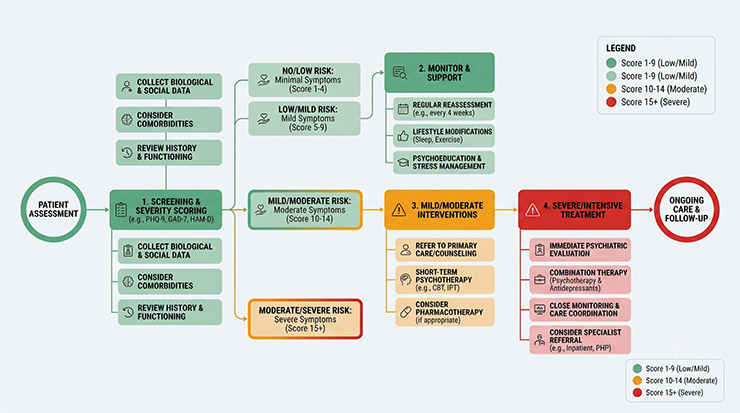
The cumulative score yielded by the questionnaire serves as a direct indicator of clinical depression severity.
Total scores range from 0 to 27, structured mathematically across five key diagnostic thresholds.
The embedded visualization framework computes this numeric variance by calculating a dynamic RGB shift based on the severity progression formula ($255 \times \text{total} / 27$ for red values).
This system transitions from a reassuring green to a high-alert red as diagnostic flags escalate. Below is an exhaustive breakdown of what these tiers mean professionally, along with standard clinical recommendation actions.

1. Minimal Depression Scale (Scores 0–4)
Scores within this spectrum suggest that depressive symptoms are largely absent or negligible.
These occasional emotional dips represent typical human responses to daily stressors rather than an underlying clinical condition.
**Proposed Treatment Action:** Clinical intervention is typically not warranted. The recommended pathway focuses on general wellness, standard stress management, and maintaining healthy sleep cycles.
2. Mild Depression Scale (Scores 5–9)
This score indicates that subtle depressive patterns are beginning to surface, though they may not yet severely disrupt daily workplace productivity or social relationships.
**Proposed Treatment Action:** Clinicians typically suggest active monitoring and a follow-up reassessment within a few weeks. Incorporating lifestyle adjustments, regular physical exercise, and cognitive reframing habits often yields positive results at this stage.
3. Moderate Depression Scale (Scores 10–14)
Crossing the threshold of **10** is a key diagnostic milestone. A score in this range indicates that symptoms are visibly impacting your quality of life, emotional stability, and general energy levels.
**Proposed Treatment Action:** It is highly recommended to seek professional counsel. A clinician will discuss a customized treatment plan, which may involve targeted psychotherapy (such as Cognitive Behavioral Therapy or CBT) or the careful introduction of pharmacotherapy, depending on your history.
4. Moderately Severe Depression Scale (Scores 15–19)
A score in this bracket signifies that depression has taken a heavy toll on daily functioning. Basic tasks can feel overwhelming, and cognitive focus may be significantly impaired.
**Proposed Treatment Action:** This tier strongly necessitates active, multifaceted treatment. A combination of professional psychotherapy and pharmacotherapy (antidepressant management) is the standard evidence-based approach to promote recovery.
5. Severe Depression Scale (Scores 20–27)
This constitutes a severe clinical state where symptoms severely restrict daily functioning across all life domains.
**Proposed Treatment Action:** Immediate professional medical intervention is required. The primary goal is to establish comprehensive safety and support, rapidly initiating a combination of medication management and intensive psychiatric or psychological care.
Crucial Notice Regarding Question 9 (Suicidal Ideation)
Special attention must be paid to Question 9, which evaluates thoughts of self-harm or being better off dead.
In professional clinical practice, if an individual scores any value other than zero on Question 9, it triggers an immediate safety protocol, **regardless of the cumulative test score**. Even if the total score is low, any positive indication on Question 9 warrants careful review and support.
Immediate Crisis Support Resources:
If you or someone you know is struggling with thoughts of self-harm or experiencing a mental health crisis, please reach out for help immediately. These services are free, confidential, and available 24/7:
- United States: Call or text 988 to reach the Suicide & Crisis Lifeline, or chat at 988lifeline.org.
- United Kingdom: Call 111 to reach the NHS mental health services, or call Samaritans at 116 123.
- International: Find a crisis line in your country by visiting findahelpline.com or bphope.com.
Data Privacy Architecture and Strict Medical Disclaimer
When managing mental health screeners online, data privacy is paramount. This interactive implementation uses a 100% client-side calculation script.
All evaluations are processed locally within your web browser. No personal answers or scores are transmitted to our servers or stored in a database.
Your data remains entirely private and secure.
Disclaimer: This self-screening tool is intended for reference and educational purposes only. It is not a diagnostic instrument and should not be used to replace professional medical diagnosis, advice, or treatment. A definitive diagnosis of clinical depression can only be made by a qualified healthcare professional or licensed psychiatrist after a thorough clinical evaluation.
Related Resources & Language Adaptations
- PHQ-9 Clinical Documentation – Wikipedia
- PHQ-9 우울증 자가진단 온라인 자동 측정 (Korean Version)
- Depression Test Online Free, Beck Depression Inventory (BDI-II)
- Dr. Phil’s Personality Test Assessment